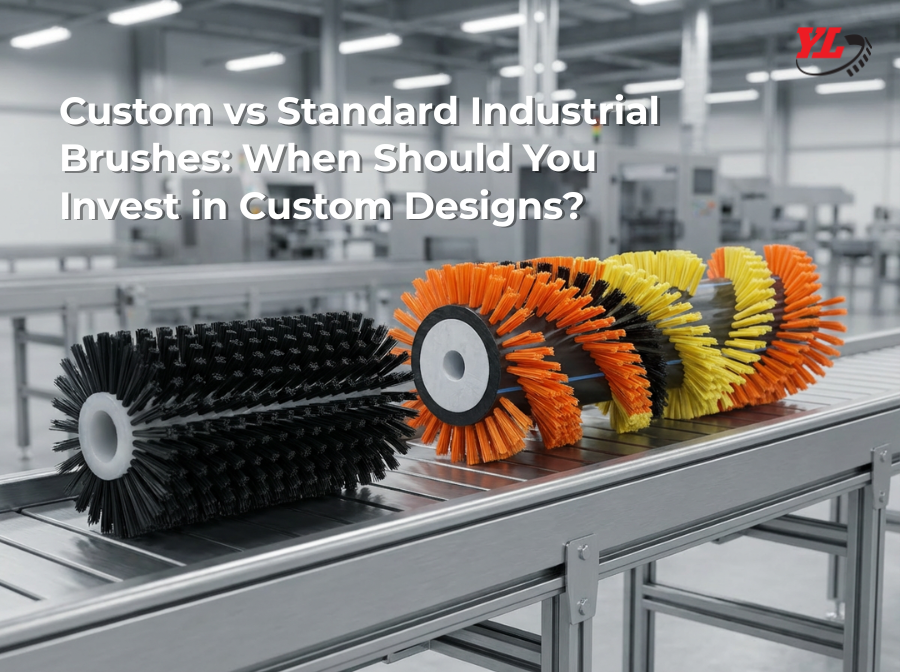
Custom vs Standard Industrial Brushes: When Should You Invest in Custom Designs?
When sourcing industrial brushes, many buyers face the same question: Should we use standard off-the-shelf brushes, or invest in custom-designed industrial brushes?
The answer is not always straightforward. While standard brushes may appear more cost-effective upfront, custom industrial brushes often deliver better performance, longer lifespan, and lower total operating costs — when applied to the right situations.
This article breaks down the decision from both an engineering and cost-justification perspective, helping manufacturers, engineers, and procurement teams make informed choices.
What Are Standard Industrial Brushes? (Definition, Pros & Limitation)
Standard industrial brushes are mass-produced brushes with fixed specifications. They are typically available in predefined sizes, materials, bristle densities, and mounting options.
Advantages of Standard Brushes
- Lower initial purchase cost
- Shorter lead time
- Suitable for basic or non-critical applications
- Easy replacement and availability
Considerations When Selecting Standard Brushes
- Best suited for standardized machine designs and common setups
- Offered in widely used bristle materials and stiffness ranges
- Performs optimally when matched to recommended applications
- Ideal for predictable operating conditions and routine processes
Standard brushes work best when operating conditions are predictable, tolerances are forgiving, and performance requirements are modest.
What Are Custom Industrial Brushes? (Design, Materials & Customization Options)
Custom industrial brushes are engineered based on specific machine parameters and operating conditions. Instead of forcing a standard brush to fit a process, the brush is designed to fit the process from the start.
- Customisation may include:
- Bristle material selection
- Bristle trim length, stiffness, and density
- Brush diameter, length, and core material
- Brush pattern (straight, spiral, V-pattern, staggered)
- Mounting methods and shaft tolerances
Custom brushes are commonly used in continuous production lines, automated systems, and applications where consistency and reliability are critical.
Engineering Perspective: Performance, Compatibility & Machine Fit
Machine Fit and Contact Efficiency
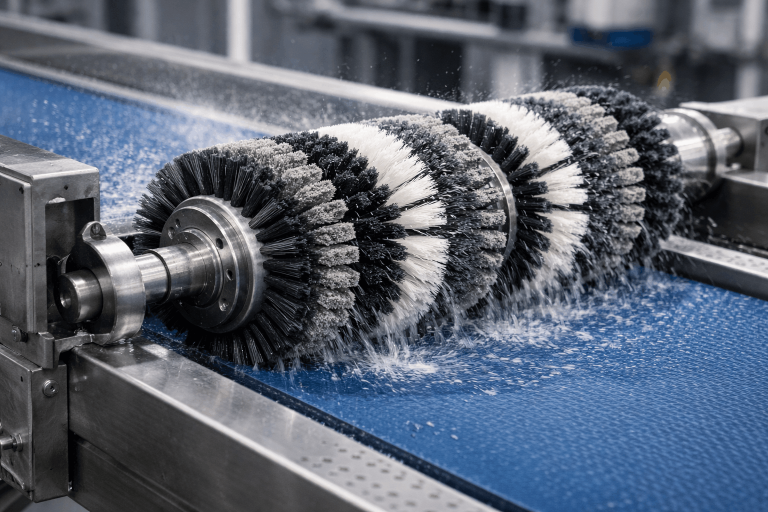
A brush that is not dimensionally optimized may result in uneven contact pressure, vibration, or incomplete cleaning. Custom brushes are designed to match:
Conveyor width and speed
Contact force requirements
Product surface geometry
This improves cleaning consistency while reducing mechanical stress on equipment.
Bristle Behaviour Under Load
Bristle material and stiffness determine how a brush behaves during operation. In standard brushes, bristle properties may be unsuitable for:
- High-speed rotation
- Fragile surfaces
Heavy debris or compacted residue
Custom brushes allow precise tuning of bristle behaviour, improving performance without over-aggressiveness.
Cost Perspective: Upfront Price vs Total Cost of Ownership (TCO)
Initial Cost Comparison
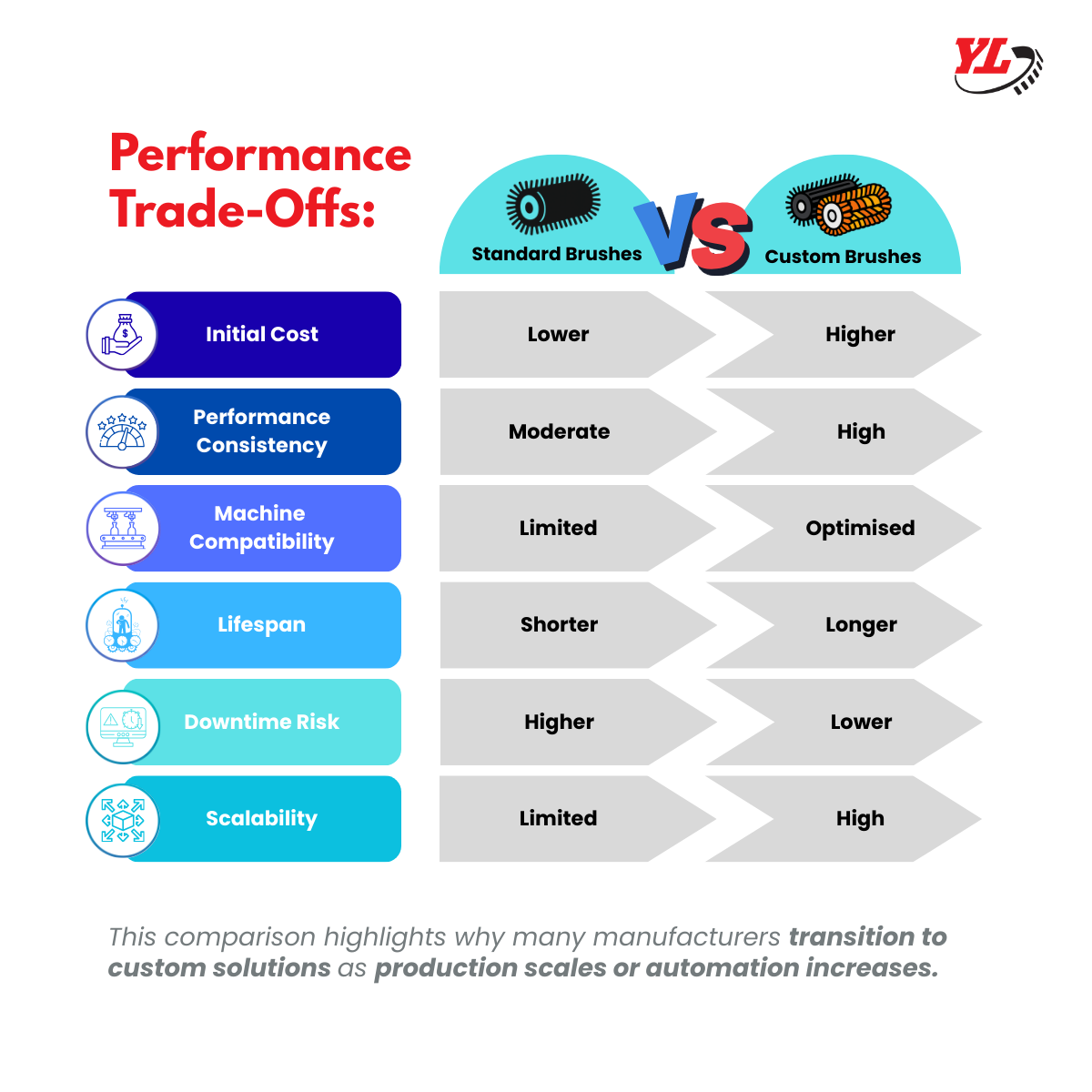
Standard Brushes: Lower upfront cost
Custom Brushes: Higher initial investment due to design and tooling
However, focusing only on purchase price often leads to higher long-term costs.
Long-Term Cost Factors Often Overlooked
Custom industrial brushes often reduce:
Replacement frequency
Machine downtime
Maintenance labour
Product rejects caused by inconsistent cleaning or finishing
When evaluated over time, the total cost of ownership (TCO) for custom brushes is frequently lower than repeated replacement of standard brushes.
When Standard Industrial Brushes Make Sense
Standard brushes are suitable when:
Production volume is low
Applications are non-critical
Equipment tolerances are flexible
Budget constraints are strict
Temporary or trial operations are involved
They are often a good starting point for early-stage production or non-specialised tasks.
When Custom Industrial Brushes Are the Smarter Investment
Custom brushes are recommended when:
Production lines operate continuously or at high speed
Downtime carries high operational costs
Surface quality must meet strict specifications
Brushes interact with automated systems
Standard brushes wear too quickly or perform inconsistently
In these scenarios, custom brushes function as engineered components rather than consumables.
How to Evaluate ROI Before Investing in Custom Industrial Brushes
Before committing to a custom solution, consider:
Current brush lifespan and replacement frequency
Cost of downtime per hour
Maintenance labour involved
Product rejection or rework rates
Expected performance improvements
Comparing these factors provides a clearer justification beyond upfront pricing.